





One of the most complex, yet promising, frontiers in cancer biology is understanding and targeting intrinsically disordered proteins (IDPs). Unlike their better-understood counterparts, these proteins do not fold into a single, predictable 3D structure. Instead, IDPs remain dynamic and flexible ensembles, and this fluidity allows them to regulate virtually every key cellular process.
Critically, many major cancer driver genes encode IDPs. Despite their essential role in cancer initiation, development, and therapeutic resistance, IDPs have long been poorly understood and broadly considered to be “undruggable, since their dynamic nature presents a significant challenge to traditional drug discovery methods.
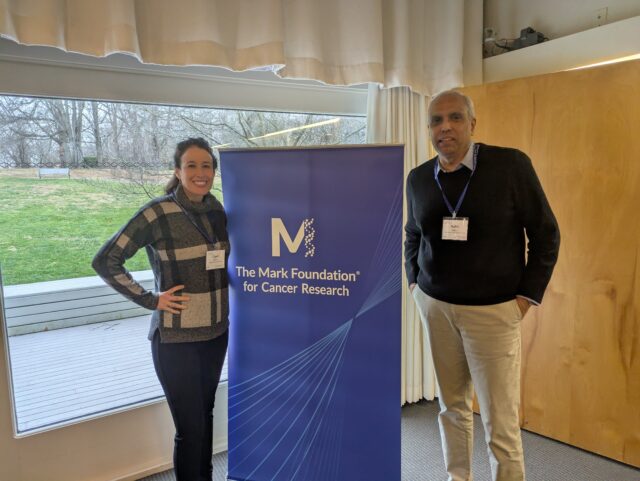
To address this knowledge gap and catalyze cross-disciplinary innovation, The Mark Foundation for Cancer Research convened a dedicated workshop, Intrinsically Disordered Proteins in Cancer, in January 2025. Held in collaboration with the Banbury Center at Cold Spring Harbor Laboratory, the workshop was organized by Cigall Kadoch, PhD, and Rohit Pappu, PhD.
The gathering united a global cohort of structural biologists, molecular biologists, biophysicists, and computational and chemical biologists. Attendees discussed IDP structure, dynamics, function, and cutting-edge methods—including the use of AI—to study and target them. Most importantly, the workshop created an opportunity for new ideas and collaborations to take root.
ASPIRE Awards: Investing in the Next Generation of IDP Research
Following the energy and insights generated at the workshop, The Mark Foundation launched a focused Request for Proposals to solicit innovative ASPIRE Award applications focused on IDPs and cancer. We are now proud to announce that we are funding three highly novel ASPIRE projects, backing teams with transformative strategies to illuminate and target this crucial area of cancer biology.
Defining the Sequence Grammars that Govern Oncogenic Regulation
Cigall Kadoch, PhD, Dana-Farber Cancer Institute
Rohit Pappu, PhD, Washington University of St. Louis
Denez Hnisz, PhD, Max Planck Institute for Molecular Genetics
The Science: This team is investigating the “sequence grammars”—distinct non-random amino acid patterning—that encode the function of intrinsically disordered regions (IDRs). They will focus on IDRs within the mSWI/SNF chromatin remodeling complex, which is frequently mutated in cancer. The project seeks to define how these grammars direct the formation of biomolecular condensates and subsequently drive oncogenic gene regulation.
The Goal: To establish a new framework for understanding how IDR grammars shape chromatin regulation, revealing new cancer dependencies and potential therapeutic targets.
The Complete Sequence-to-Function Mapping of BRCA1
Steven Boeynaems, PhD, Baylor College of Medicine
The Science: Despite advances in personalized cancer genetics, thousands of BRCA1 variants remain classified as “variants of unknown significance” (VUS), creating immense clinical uncertainty for patients. Predictive algorithms struggle to classify these variants, especially in proteins like BRCA1 with extensive disordered regions.
The Goal: Using a newly developed cloning and screening platform, Dr. Boeynaems will generate and assay an ultra-large library encompassing all possible BRCA1 missense variants to build a complete sequence-to-function map. This work will provide the functional data necessary for clinicians and patients to make informed, life-altering decisions
Identifying the Molecular Mechanisms and Vulnerabilities of Disordered Transcription Factor Oncofusions
Benjamin Sabari, PhD, UT Southwestern Medical Center
The Science: Chromosomal translocations often create potent oncofusion proteins that combine transcription factor DNA-binding domains with highly active IDRs. These IDRs drive transcriptional hyperactivation and the formation of oncogenic condensates in numerous cancers.
The Goal: Dr. Sabari’s project will define the biochemical and biophysical rules underlying oncofusion IDR function. By systematically mapping the sequence features that drive transcriptional machinery recruitment, the work aims to uncover vulnerabilities intrinsic to these IDRs, paving the way for targeted therapeutic strategies against this class of disordered fusion proteins.
A Unified Approach to Undruggable Targets
By addressing the fundamental roles of IDPs in cancer, these teams are opening up entirely new avenues for drug discovery — and thanks to the unique proof-of-concept focus of ASPIRE award funding, they have the flexibility to follow the science where it goes.
“The work on intrinsically disordered proteins is one of the most exciting and critical areas in cancer research today. It represents an opportunity to move beyond what we currently consider ‘undruggable,’” said Ryan Schoenfeld, PhD, CEO of The Mark Foundation. “By convening experts and backing these high-risk, high-reward ASPIRE projects, we are accelerating the fundamental science needed to unlock novel prevention and treatment strategies for a wide array of cancers.”